


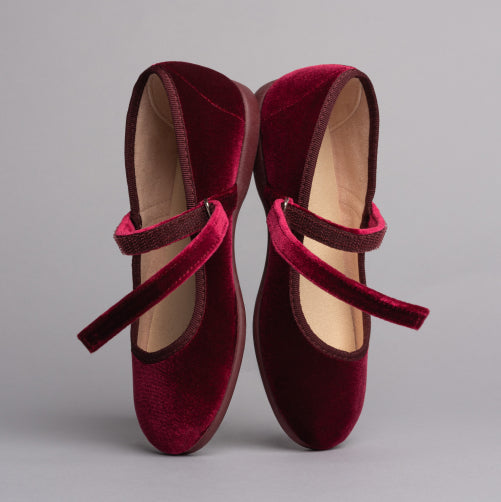
The Difference Between Mary Janes and Ballet Flats for Girls
People say Mary Janes, ballet flats, and ballerinas as though they are all the same shoe. They are not, and once you know what to look for, the difference between Mary Janes and ballet flats is easy to spot in a single glance at the strap. We are Cori and Isa, the founders of Marjen, and between the two of us we have spent seven years designing both styles and just as many years watching them survive, or not survive, an actual school year on our own daughters' feet. This guide clears it up simply, no jargon, no guesswork.
If you are short on time: the main difference is the strap. A Mary Jane has a strap across the instep that holds the foot securely in place, which is why it suits active girls and younger children so well. A ballet flat is a slip-on with no fastening at all, which gives it a quieter, daintier look. That is the whole answer. Read on for when to choose each.
What is a Mary Jane?
A Mary Jane is a low-cut shoe with a rounded toe and a strap that crosses the instep, usually fastened with a buckle or, in our case, an adjustable Velcro closure. That strap is the whole point. It holds the shoe in place through running, climbing, and the general physics of being a child, which is exactly why the style has stayed in children's wardrobes for over a century. At Marjen we make ours in family run workshops in Alicante, Spain, and Felgueiras, Portugal, in canvas, leather, velvet, and corduroy, but the strap across the instep is the one detail every version shares.
What is a ballet flat?
A ballet flat is a slip-on shoe inspired by a dancer's slipper. It has no strap and no closure of any kind, just a low, close cut silhouette that relies entirely on a snug fit to stay on the foot. Its whole personality is minimalism: no hardware, no fastening, just a clean line from toe to heel. That simplicity is what gives it a sleeker, more grown up look than a Mary Jane, and also what makes it far less forgiving on a foot that is still growing.
What is the difference between Mary Janes and Ballet Flats?
The core difference comes down to one detail: the strap. A Mary Jane has one across the instep. A ballet flat does not. Everything else about how these two shoes wear, fit, and behave on a child follows from that single design choice.

From where we sit, the strap changes more than fit. It changes how long a shoe stays comfortable. A ballet flat has to be sized almost perfectly to stay on at all, and because children's feet grow in weeks not years, that perfect window closes fast. A Mary Jane's strap adjusts around wherever the foot actually is that month, so the shoe keeps its security and its comfort well past the point a flat would start slipping at the heel.
Which should you choose?
The right choice comes down to the occasion, your daughter's age, and how active she is that day. Here is how we would break it down.
When to choose Mary Janes for girls:
- School and uniforms
- First steps and younger toddlers
- Full days of play
- Ceremonies where you still want the shoe to stay on
This is where construction matters most. A Mary Jane built for real wear needs a flexible, non-slip sole that bends with a developing foot rather than fighting it, and a strap sewn securely enough to survive being pulled on and off by small hands every single day. Every Marjen pair is cut, sewn, and finished by hand by artisans whose families have made shoes for generations, specifically so the strap holds up to that kind of daily use rather than loosening after a few months.
When to choose Ballet Flats for girls:
- Dressier and more formal looks
- Dance-inspired outfits
- Older girls who walk confidently and can keep a slip-on on
We will be honest about the trade-off, because that is the only way this guide stays useful: a ballet flat is genuinely less secure for a very active or very young child. It suits an older girl whose feet have mostly finished growing and whose day involves more sitting and standing than sprinting. For that child, in that moment, a ballet flat is a lovely choice.
FAQs
Are Mary Janes and ballet flats the same thing?
No. They look similar at a glance, both being low, rounded toe shoes, but a Mary Jane has a strap across the instep and a ballet flat is a strapless slip-on. That single difference changes how each shoe fits, how long it stays on, and which occasions and ages it suits best.
Are Mary Janes or ballet flats more comfortable for girls?
For most children, Mary Janes. The strap holds the foot securely without requiring a perfect fit, which means less rubbing, less slipping, and less of the toe curling children do to keep a loose shoe on. Ballet flats can be just as comfortable, but only when the fit is close to exact, which is harder to maintain on a growing foot.
Are Mary Janes good for school?
Yes. The secure strap holds up through a full school day of recess, stairs, and gym class, and many styles, including ours, are machine washable, which matters for a shoe worn five days a week. Mary Janes also meet most school uniform requirements thanks to their classic, tidy silhouette.
Can young children wear ballet flats?
They can, but a young or very active child will likely lose them more often than an older, calmer child would. Without a strap to hold the shoe in place, a ballet flat depends entirely on a snug fit, and young feet change size too quickly for that fit to last long. A Mary Jane is generally the more practical choice until a child is old enough to walk confidently and keep a slip-on shoe on all day.