




Best Mary Jane Shoes for Kids With Wide Feet (2026)
A wide foot is not a problem you solve by buying a bigger size. It is a different shape, not a smaller version of the same shape scaled up, and a bigger shoe usually just means more room everywhere at once: heel slippage, too much volume in the arch, a shoe that somehow still does not fit any better than the first one did.
This guide comes from Cori and Isa, the founders of Marjen, who have spent twelve years making shoes that accommodate wide feet without creating new problems in the process. Between the two workshops we work with and thousands of conversations with parents whose daughters have wide feet, we have learned exactly which details matter: room at the front, hold at the back, and a strap that adjusts as her foot changes shape through the day.
Here are the six features that actually solve the problem.
1. Round toe box
- Best for: Feet that are widest across the toes
- What to look for: A front that stays round instead of tapering to a point
A wider foot is often widest across the toes, not through the middle of the foot, which most shoes are not built to account for. Most tapered designs narrow from the instep toward the toe, leaving a child with a wide forefoot nowhere to go. The pressure concentrates on the little toe, squeezed against the side of the shoe for hours at a time.
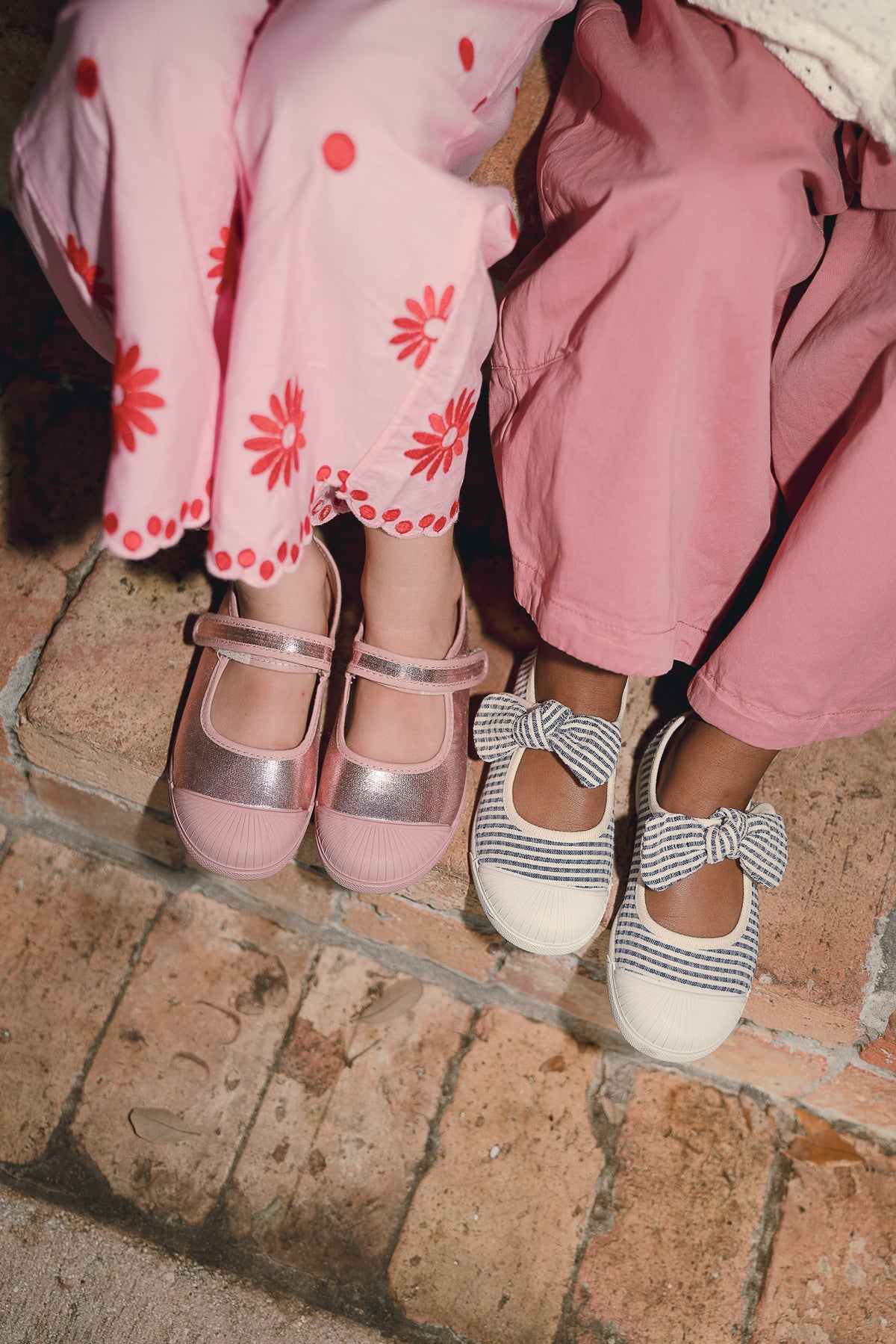
Over months, that pressure leaves a mark: a permanent groove, a blister, sometimes a callus that never fully goes away. A round toe box spreads that same pressure evenly across all five toes instead of loading it onto one. It is the first thing we would check when shopping for a wide foot. Girls' Mary Janes - A truly round toe box is harder to find than it should be, since most designers still taper toward a point because it photographs as more delicate. But that delicate line is exactly what creates the pain.
How to check it at home: Look at the shoe from above. The widest point should sit at the toes, not behind them.

2. Extra depth through the instep
- Best for: High insteps, which are often confused with wide feet
- What to look for: Vertical room between the footbed and the strap
This is the confusion we clear up most often, and it might be the single most useful thing in this whole guide. A high instep is not the same thing as a wide foot. A high instep means the top of the foot, the bridge where the strap sits, is taller than average. A wide foot means the foot itself is wider. A child can have either, both, or neither.
If her strap closes cleanly but leaves a red line across the top of her foot, or if she says the strap feels tight even though the shoe fits everywhere else, that is a high instep talking, not a wide foot. The fix is depth, not width. A shallow shoe built wide will still pinch her bridge even with plenty of room at the sides.
How to check it at home: If the strap closes but leaves a red line across the top of the foot, the shoe is too shallow, not too narrow.
3. Adjustable strap
- Best for: Feet that swell over the course of the day
- What to look for: Hook-and-loop, or a buckle with more than one hole
A child's foot changes volume through the day. It swells at recess, swells in a warm classroom, swells further after any real activity. A fixed elastic closure has no way to account for that, so it ends up either tight in the morning or loose by afternoon. On a wider foot, that gap becomes a real problem rather than a minor annoyance.
A strap loose enough for afternoon swelling will not hold the foot securely first thing in the morning. One tight enough for morning security will pinch by midday. An adjustable strap, whether Velcro or a buckle with multiple holes, lets her foot expand and settle through the day without losing its hold. This matters more on a wide foot than a standard one, since there is far less margin for error to begin with.
How to check it at home: Fasten it in the morning, then check it again after a few hours of wear.

4. Oversized opening
- Best for: Kids who fight getting shoes on, and for anyone using orthotic insoles
- What to look for: A strap that opens wide and folds back out of the way
A shoe that is roomy through the foot but has a narrow opening creates its own daily struggle. A wider foot needs more room to slide in, and a tight strap opening cancels out whatever room the shoe offers everywhere else. Look for a strap that opens wide enough that she can slide her own foot in without you having to stretch it open by hand. This matters twice as much if she wears orthotic insoles, since orthotics take up real volume, and a narrow opening makes them nearly impossible to fit around.
How to check it at home: She should be able to slide her foot in without you widening the opening for her.
5. Soft leather upper
- Best for: Feet that mark or blister easily
- What to look for: Leather that gives when you press it, not stiff synthetic
A wider foot puts pressure in places a standard shoe was never built to handle. Stiff leather, and worse, stiff synthetic, will mark the skin, cause blisters, and never really soften with wear. Soft leather does the opposite: it yields to the shape of her foot and keeps softening the longer she wears it, molding around her foot instead of forcing her foot into its shape.
The Spanish leather we use in our own workshop is tanned specifically to prioritize softness over shine. It starts soft and only gets softer. That is worth paying for on a wide foot especially, since a shoe that works with her foot instead of against it is the one that survives the season without causing pain along the way.
How to check it at home: Press the side of the shoe with your thumb. It should yield, then spring back.

6. Firm heel counter
- Best for: Wide feet that slip at the heel once there is enough room at the front
- What to look for: A back that holds its shape when squeezed
This is the detail that trips up most parents. A shoe that is roomy at the front should be roomy everywhere, right? Not quite. A wide foot actually needs room at the front and hold at the back, and those two things are not in conflict, even though it can feel that way while shopping. The heel counter, the structure built into the back of the shoe, should stay firm when you pinch it rather than collapsing flat. A soft heel counter gives way under the pressure of walking, and her heel slips a little more with every step. A firm one keeps the heel exactly where it belongs, even with plenty of width up front.
The best Mary Janes hold both truths at once: a round toe box that never crowds, and a heel counter built firm enough to do its job. It is the combination, not either detail alone, that makes a wide fit actually work.
How to check it at home: Pinch the back of the shoe. If it collapses flat, it will not hold her heel.
FAQs
How do I know if my child has wide feet?
The most reliable way is to measure at home. Have her stand on a piece of paper in bare feet and trace around her foot with a pencil, then measure the width at the widest point and compare it to a standard shoe size chart.
Another sign is if she complains that her shoes feel tight across the toes even though the length fits, or if you can see her toes spreading to the sides of the shoe when she stands. A shoe that constantly leaves red marks across the sides of her foot is also a clear signal. Some children inherit wide feet from their parents, so if you or your partner wear wide sizes, your daughter probably does too.
What's the difference between wide feet and a high instep?
A wide foot means the actual width of the foot from side to side is bigger than average. A high instep means the top of the foot, where the strap sits, is taller than normal. You can have both, one, or neither.
The easiest way to tell is to look at where the shoe pinches. If the strap closes but leaves a red line across the top of her foot, she has a high instep, not a wide foot. If the sides of the shoe squeeze her toes or leave marks on the outer edge of her foot, she has a wide foot. A high instep needs extra depth at the top; a wide foot needs width in the toe box. Confusing the two means buying a shoe that still doesn't fit.
Should I buy a bigger size if my child has wide feet?
No. Buying a bigger size gives her room everywhere, extra length, extra arch room, extra heel space, which creates new problems like heel slippage and too much volume in the arch. A wide foot needs a shoe built in a wide width, not a larger size. If your child wears a size 2 in standard width, she needs a size 2 in wide width, not a size 3. A properly fitted wide shoe will be snug in the length and at the heel while still being roomy across the toes and instep.
Are Mary Janes a good choice for wide feet?
Yes, if you choose the right Mary Jane. A Mary Jane with a round toe box, adjustable strap, and firm heel counter is actually one of the best choices for a wide foot because the strap holds the foot securely without requiring a perfect fit. The strap does the work; the shoe stays on even though there is more width.
Read more

Back to school means new shoes. It also means a whole new round of small stresses. The shoe has to match the uniform, survive recess, stay on through a full day, and somehow fit right on the first ...
Color is the fastest way to match a Mary Jane to an occasion, faster than checking the material or the strap style, because most dress codes and most parties tell you the color before they tell y...